
Updated August 5, 2026
A Plain-Language Guide to PLU Codes

I used to peel the little sticker off my apples, bananas, and oranges without giving it a second thought. I assumed it was just there for the cashier.
Then I started wondering what those numbers actually meant.
Like many people, I’d heard two things over the years:
- A number beginning with 9 means organic.
- A number beginning with 8 means GMO.
One of those is true. The other has a much more interesting story.
Rather than repeating what I’d seen on social media or other websites, I decided to go directly to the source. I wanted to know what those little stickers were actually designed to tell us.
Here’s what I found.
What is a PLU Code?
PLU stands for Price Look-Up.
It’s the four- or five-digit number printed on the small stickers attached to loose fruits, vegetables, herbs, nuts, and dried fruit.
These codes help grocery stores identify produce quickly at checkout while also supporting pricing and inventory.
According to the International Federation for Produce Standards (IFPS), the organization responsible for assigning these codes, each number identifies a specific produce item and sometimes even its variety or size.
Think of it like a phone number. The number itself doesn’t tell you much unless you have the directory. The one exception is the first digit on some five-digit codes, which can tell you how the produce was grown.
PLU codes have been in use since 1990. Even though they’ve been around for decades, they often cause confusion because most shoppers aren’t told what they actually mean.
One thing that’s helpful to know is that they’re not required by law. They’re a voluntary industry standard that most grocery stores choose to use because they make produce easier to identify and sell.
The Two Most Common PLU Myths
If you’ve searched online for information about produce stickers, you’ve probably seen these claims repeated:
✔ A number beginning with 9 means organic.
❌ A number beginning with 8 means GMO.
Only one of those is still true.
The “8 Means GMO” Myth
This is probably the biggest misconception about PLU codes.
Years ago, the number range beginning with 8 was reserved for genetically modified produce. The important part is what happened next. Growers never adopted the system.
Because it was rarely, if ever, used, the IFPS later reassigned that number range for general conventional produce once other number ranges became full.
Today, an 8-prefix should not be interpreted as meaning GMO.
In fact, the PLU sticker was never a reliable way to identify genetically modified produce, and today it doesn’t answer that question at all.
If you’re specifically looking for products that meet non-GMO standards, the Non-GMO Project Verified seal is a much more reliable indicator than a PLU code.
The Good News About the Number 9
This is the part that is true.
If a standard four-digit PLU code begins with a 3 or 4, adding a 9 to the beginning creates the organic version of that same produce item.
For example:

The item’s standard four-digit code stays the same. Adding a 9 to the beginning identifies the certified-organic version.
When buying organic produce, it’s also helpful to look for the USDA Organic seal on the shelf tag or packaging. Unlike PLU codes, that certification is regulated by the U.S. Department of Agriculture.
At a Glance
4 digits
Usually begins with 3 or 4
Conventionally grown
5 digits beginning with 9
Certified organic
5 digits beginning with 8
Not a reliable GMO indicator
What Does “Conventionally Grown” Actually Mean?
This is another area that’s easy to misunderstand.
- A four-digit PLU code doesn’t tell you which pesticides were used.
- It doesn’t tell you how much pesticide residue is present.
- It doesn’t even tell you whether pesticides were used at all.
It simply tells you the produce was not sold as certified organic.
Conventional farming is allowed to use synthetic pesticides, herbicides, insecticides, fungicides, and fertilizers when appropriate, but which products are used, and whether they’re used at all, depends on the specific crop, farm, growing conditions, and region.
That’s why a PLU code should never be used to draw conclusions about pesticide exposure.
What PLU Codes Don’t Tell You
Knowing what a tool can’t do is just as useful as knowing what it can.
A PLU code doesn’t tell you:
- Where the produce was grown
- Whether it’s locally grown
- When it was harvested
- Which pesticides were used
- Whether it tastes better
- Whether it’s fresher than another item
It simply identifies the produce and, in some cases, how it was grown.
What If There’s No Sticker?
Not every piece of produce will have a PLU sticker. This is especially common at farmers’ markets, local farm stands, and some specialty grocery stores.
If there’s no sticker:
- Check the shelf sign or produce bin label.
- Ask someone working in the produce department.
- Remember that some stores use their own internal coding system.
The Practical Takeaway
The good news is you don’t need to memorize hundreds of PLU numbers.
The most useful things to remember are:
✔ A five-digit code beginning with 9 identifies certified organic produce.
✔ Don’t rely on an 8 to identify GMO produce.
✔ Use the USDA Organic seal or Non-GMO Project Verified seal when those distinctions matter to you.
✔ Keep a quick-reference guide handy for the produce you buy most often.
That’s exactly why I created the free PLU Quick Reference Guide. It’s designed to be saved to your phone so you can quickly check it while you’re shopping.
Download Free PLU Reference Guide
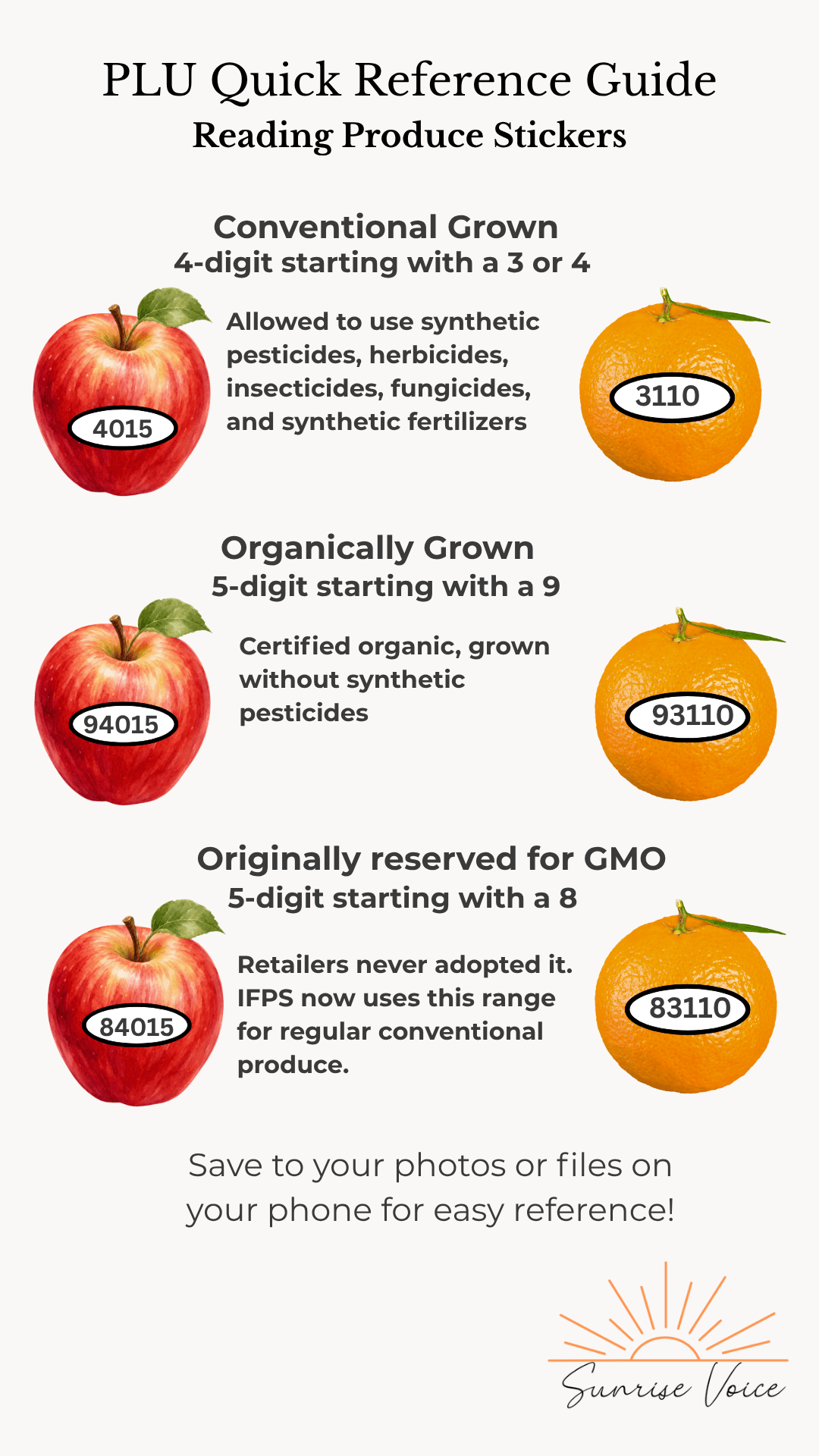
PLU Reference Guide
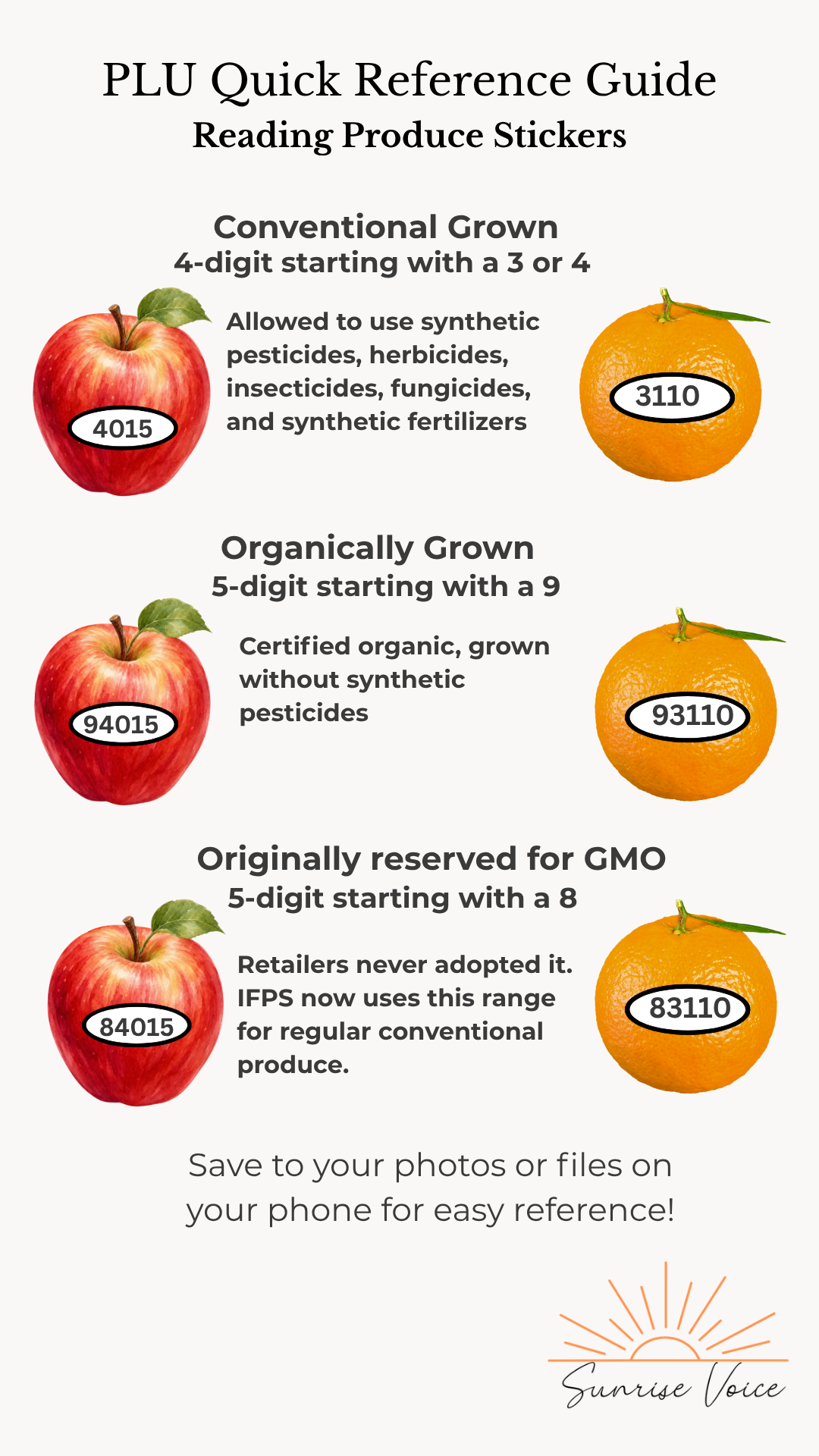
Download or save this PLU Reference Guide to your phone or other device for easy reference. This is an image and can be saved on your phone.
The Practical PLU Code Guide

The Practical PLU Code Guide is a printable grocery shopping reference that explains how to read PLU produce stickers, identify certified organic produce, and separate common myths from facts.
Available on the Sunrise Voice Etsy shop for an instant download.
This post is part of Know Before You Buy, a growing collection of guides that take confusing grocery store and food label information and turn it into something you can actually use. I’ll be adding related topics on food, wellness, and smart choices as the collection grows, so check back for what’s next.
Want to know when a new guide or Collection drops? Sign up for updates and I’ll let you know when something new is ready, no set schedule, just a note when there’s something worth your time.
Source
I researched this using primary sources, going directly to the International Federation for Produce Standards (IFPS), the organization that actually develops and maintains the international PLU coding system, rather than relying on summaries.
Additional references include information from the USDA Organic Program and the Non-GMO Project to explain related food labeling systems.